China Top 10 Enameled Copper Flat Wire Manufacturers?

Time:2026-10-05 Author:Isabella
0%

China has become a major production base for Enameled Copper Flat Wire, supporting electric vehicles, traction motors, transformers, and industrial drives. The opportunity is substantial. The International Energy Agency reported in Global EV Outlook 2025 that global electric car sales exceeded 17 million in 2024, representing more than one-fifth of new car sales. This growth increases demand for compact, thermally efficient winding materials.

Industry reports also point to copper’s continuing importance in electrification. The IEA’s Global Critical Minerals Outlook 2024 identifies copper as essential for power networks, electric transport, and clean-energy equipment. Grand View Research’s copper market analysis highlights expanding demand from electrical and transportation applications. These findings provide useful context for examining China’s leading enameled flat wire manufacturers, although market reports rarely reveal every factory’s real production capability.

This guide will assess manufacturers through practical criteria. These include conductor dimensions, enamel systems, temperature ratings, bonding performance, electrical breakdown strength, and dimensional consistency. Certifications, laboratory testing, delivery records, and experience with customized winding designs also matter. A polished website is not enough. Sample approval is essential. Buyers should request technical datasheets, inspection records, and application references before selecting a supplier. Factory audits can reveal details that brochures omit, such as edge quality, spool handling, and coating uniformity at high speed. No ranking is perfect. Supplier strengths change by project, material grade, and production schedule. Therefore, this list should support careful comparison rather than replace professional qualification.
China Top 10 Enameled Copper Flat Wire Manufacturers?

What Is Enameled Copper Flat Wire?

Enameled copper flat wire is a rectangular copper conductor covered by a thin insulating enamel layer. Unlike round wire, its broad surface uses motor and transformer slots more efficiently. This can increase copper fill and reduce wasted space. The enamel also separates adjacent turns without adding bulky paper insulation.

According to IEC 60317-0-2, manufacturers must control dimensions, insulation quality, thermal endurance, and electrical breakdown performance. Practical checks include coating adhesion, pinholes, flexibility, and resistance after heat exposure. Thermal classes matter. A wire rated for 180°C may suit compact motor windings, but the complete insulation system still needs testing. A catalog number is not proof.

Demand is linked to electrification. The IEA’s Global EV Outlook 2024 projected more than 17 million electric-car sales worldwide in 2024. Its Electricity 2024 report also expected global electricity demand to grow by about 3.4% annually from 2024 to 2026. These trends support demand for efficient winding materials in motors, generators, and transformers. When comparing Chinese manufacturers, buyers should request cross-section tolerances, conductor resistance, enamel thickness, thermal-class evidence, and batch test records. Short samples help. Flat wire can look precise but still fail at tight bends; I have seen specifications hide that practical weakness.

How to Evaluate Chinese Flat Wire Manufacturers

Evaluating Chinese enameled copper flat wire manufacturers requires more than comparing quotations. The IEA’s Global EV Outlook 2024 reported over 14 million electric cars sold worldwide in 2023. This growth increases demand for compact, heat-resistant winding conductors. Ask suppliers for conductor width, thickness, corner radius, and dimensional tolerances. Request recent inspection records, not only catalog claims. Samples should match production material.

Check enamel performance against the relevant IEC 60317 specification. Review breakdown voltage, thermal class, adhesion, flexibility, and resistance to refrigerant or varnish where applicable. The International Copper Study Group continues to forecast rising refined copper demand, although its market estimates can change quickly. This matters. A manufacturer should explain copper sourcing, conductivity results, and batch traceability without hesitation.

Factory evaluation also needs practical evidence. Visit the line if possible. Observe enamel coating, curing ovens, online spark testing, and reel packaging. Ask for test reports from qualified laboratories and confirm calibration dates. Compare five production batches, not one perfect sample. I have seen suppliers provide excellent samples but inconsistent corner coating later. That weakness is easy to miss. Delivery capability, moisture protection, export documentation, and corrective-action records deserve equal attention. A lower price may hide higher scrap, unstable insulation, or longer qualification time. Check everything twice.

China’s Top 10 Enameled Copper Flat Wire Manufacturers

China’s Top 10 Enameled Copper Flat Wire Manufacturers are usually judged by measurable production capability, not advertising claims. Reliable factories use high-purity copper, controlled rolling, and stable enamel coating lines. Buyers should check width tolerance, corner radius, insulation thickness, and conductor resistance. Small deviations can affect winding efficiency and heat dissipation.

A professional evaluation also examines thermal aging, pinhole testing, adhesion, flexibility, and breakdown voltage. Samples matter. Ask for batch records, inspection reports, and traceable material certificates before placing a large order. Manufacturers serving transformers, motors, generators, and electric vehicles often provide custom dimensions and multiple insulation classes. Their laboratories should use calibrated equipment and repeat tests under documented conditions. A polished brochure is not proof.

The most dependable suppliers explain production limits clearly. They discuss minimum order quantities, tooling costs, lead times, packaging, and export documentation without vague promises. Factory visits can reveal details that websites hide, such as worn dies, poor edge control, or inconsistent storage. No ranking stays perfect. Capacity, quality systems, and delivery performance can change after one year. I would compare recent samples, audit findings, and customer references before calling any manufacturer a top-ten choice. Sodium-free packaging, dry storage, and protective separators also deserve attention during shipment.

Product Range, Technologies, and Quality Standards

China’s leading enameled copper flat wire manufacturers are usually judged by product range and process control, not catalog size. Common products include rectangular copper wire for transformers, motors, generators, and high-frequency coils. Buyers may request different conductor widths, thicknesses, corner radii, and insulation classes. Some factories also provide self-bonding coatings or combined insulation systems.

The details matter.

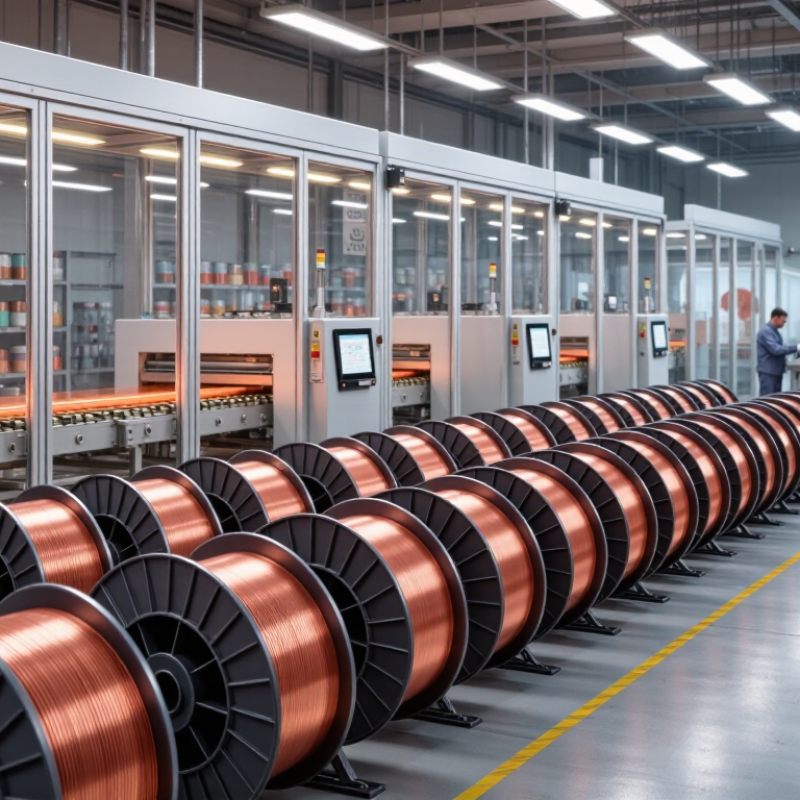
Advanced lines use precision drawing, multi-pass enamel coating, and controlled curing ovens. Online laser gauges can monitor dimensions continuously. Pinholes, surface scratches, and uneven edges still need manual inspection. Reliable suppliers test electrical resistance, breakdown voltage, elongation, adhesion, flexibility, and heat shock. These checks should follow recognized requirements such as IEC 60317, relevant GB/T standards, and agreed customer specifications. RoHS and REACH documentation can support responsible international purchasing.

Quality records should identify each production batch. Samples should match the approved technical drawing. I would also inspect packaging, because moisture can damage insulation before installation. A polished factory tour proves little by itself. Independent testing may reveal variation between the first and tenth coil. Some product claims sound stronger than the evidence. That deserves scrutiny. Audits, traceable reports, and repeat sample testing offer more dependable evidence than promises.

How to Choose the Right Chinese Manufacturer

Choosing a Chinese manufacturer for enameled copper flat wire requires more than comparing quotations. Start with technical fit. Share the conductor width, thickness, corner radius, enamel grade, thermal class, and expected voltage. A reliable factory should return clear tolerances, test methods, and production limits. Ask for samples from normal production, not specially selected pieces. Check insulation thickness, pinholes, adhesion, flexibility, and resistance after heat exposure.

Factory evidence matters. Request recent inspection records and traceability from copper rod to finished coil. Confirm whether testing is performed in-house or by an independent laboratory. Useful equipment includes precision rolling lines, online dimension controls, spark testers, and temperature-controlled curing ovens. Review quality certifications, but do not treat certificates as proof of every capability. Audit the facility, remotely or in person, and compare its answers with sample results.

Communication can reveal hidden risk. A capable supplier should explain edge cracking, enamel damage during winding, delivery capacity, and corrective actions. One low quotation may hide larger minimum orders or weaker process control. I once focused too heavily on price and overlooked inconsistent corner dimensions. The samples passed basic checks, yet winding performance suffered. That mistake was avoidable. Ask for a pilot order, define acceptance limits in writing, and require a documented response for defects. Delivery history, packaging details, replacement policy, and stable contact personnel also deserve attention. A manufacturer that admits limitations may be safer than one promising everything.

FAQS

What is enameled copper flat wire?

It is a rectangular copper conductor covered with a thin insulating enamel layer. Its broad shape uses winding slots efficiently.

Why is flat wire used in motors and transformers?

It can increase copper fill and reduce unused space. The enamel separates adjacent turns without bulky paper insulation.

What specifications should buyers request?

Request width, thickness, corner radius, conductor resistance, enamel thickness, and thermal-class evidence. Approved drawings should show tolerances clearly.

Does a 180°C rating prove the winding system is safe?

No. A 180°C wire may suit compact motor windings, but the complete insulation system needs separate testing.

Which quality checks are important?

Check breakdown voltage, resistance, adhesion, flexibility, elongation, heat shock, pinholes, scratches, and uneven edges. Small defects matter.

How do advanced factories control production?

They may use precision drawing, multiple coating passes, controlled curing ovens, and online laser gauges. Manual inspection remains necessary.

How can buyers compare manufacturers in China?

Compare batch records, cross-section tolerances, test methods, sample consistency, and traceability. A polished factory tour proves little.

Why are samples important before placing an order?

Short samples can reveal bending problems, uneven enamel, or dimensional variation. Flat wire may look precise but fail at tight bends.

What documents support responsible international purchasing?

Buyers may request IEC 60317 evidence, relevant GB/T records, RoHS documents, REACH documents, and agreed customer specifications.

How should enameled flat wire be stored and packaged?

Inspect packaging carefully and keep moisture away from the insulation. The first coil may differ from the tenth coil. That deserves checking.

Conclusion

This article provides a practical guide to China’s top 10 Enameled Copper Flat Wire manufacturers without focusing on individual brand names. It explains the structure, insulation characteristics, thermal performance, electrical conductivity, and typical applications of Enameled Copper Flat Wire in transformers, motors, generators, and other power equipment. Readers will also learn how to evaluate manufacturers by examining production capacity, engineering expertise, material traceability, testing procedures, delivery reliability, and customer support.

The article compares the product ranges, manufacturing technologies, and quality standards commonly used by leading Chinese suppliers. It highlights important considerations such as conductor dimensions, enamel types, insulation thickness, temperature ratings, bonding performance, dimensional tolerances, and compliance documentation. Finally, it offers a straightforward framework for selecting the right manufacturer according to application requirements, technical specifications, order volume, budget, quality expectations, and long-term cooperation goals.

Isabella

Isabella

Isabella is a dedicated marketing professional with a sharp focus on driving brand growth and engagement through strategic content creation. With an extensive background in digital marketing, she combines her passion for storytelling with her keen understanding of industry trends to deliver......